Home > Family > Salah
My daughter asked me what I say in sujood. I told her I'd teach her properly when she was older.


“Mama, what do you say when your head is on the floor?”
Amira was six and a half. For a few months she’d been lining up next to me for Maghrib, copying everything I did about a second late.
I told her I was praising Allah. She wanted the actual words.
“I’ll teach you properly when you’re older, habibi. When you’re seven.”
It sounded like a plan. Seven is the age the hadith mentions, and it was only a few months away. Honestly, though, I was buying time.
I’ve prayed my whole life. My mother taught me, sitting on the edge of her bed. But somewhere between then and now, parts of the prayer had gone quiet in my head. I could get through the tashahhud, but I couldn’t have written it down for her.
“Say it after me.”
So in the meantime, I whispered.
Every rakah, Amira waited with her head tilted toward me for the next word. When I went into sujood, she stopped. When I lost my place because I was listening for her, we both stopped.
It was sweet for about a week. After that, I started to notice my own prayer had turned into a teaching session. I wasn’t praying anymore. I was prompting.
The things I tried first

- The printout from Sunday school. Her teacher gave it to every child, which was kind of her. It worked while she was standing, but in sujood it was gone, and she’d come back up hunting for it.
- A video on the tablet. She learned the melody quickly. The tablet also became the thing she wanted to look at.
- An app with a voice. She’d pause the prayer to press play.
- Me, standing next to her. I can do that for Maghrib. I can’t do it at school for Dhuhr, or at her grandmother’s house, or for the rest of her life.
Each of these worked for a day or two.
“Idris reads it off his mat.”
Hana’s son is in Amira’s Sunday class. At pickup one afternoon I mentioned it, half joking. The whispering, the printout, the tablet.
She laughed. “Same. Then I got Idris a prayer mat with the words printed on it.”
My first thought was the same question you might be having right now: isn’t reading during salah a problem? Isn’t that cheating?
“That’s exactly what I asked,” she said. “Then I thought about how we learned Quran. Somebody put the page in front of us. You look until you don’t need to look.”
Looking is how you learn
That sentence stuck with me all evening.
I’d been treating “she still needs to look” as a failure. But every child who has ever learned al-Fatihah looked at something first: a page, a teacher’s lips, a parent’s face. The goal was never that she’d never look. The goal was that one day she wouldn’t need to.
The mat Hana meant is the Sajada phonetic prayer mat. The steps of salah are printed on it in order, in Latin letters, with a small drawing of each position beside the words.
The next word is where her eyes already are
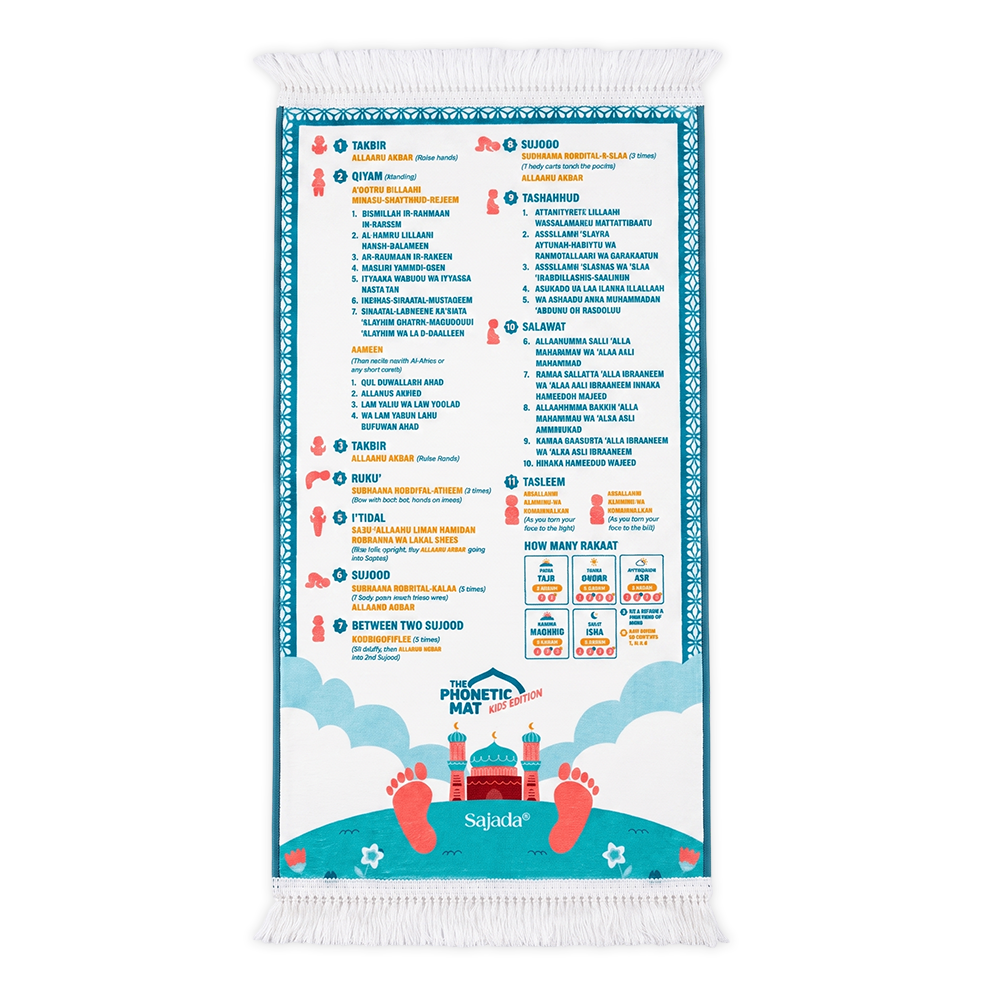
This is what I couldn’t solve with paper or a screen.
On the mat, the words sit exactly where a child’s eyes go anyway. When she stands, the words are in front of her. When she bows, she’s looking straight at the next line. In sujood nothing slides away, because the page is the floor.
The kids’ edition is 90 × 50 cm (35 × 20 in), sized so a child isn’t lost on an adult mat. It has 1.5 cm (0.6 in) of foam, which I didn’t think mattered until I watched her kneel on it without fidgeting.
See the kids’ matThere’s no Arabic script on it
This was my second worry. I didn’t want Allah’s name in Arabic under anyone’s feet, especially a seven-year-old who doesn’t always think about where she’s stepping.
The mat is printed only in Latin-letter phonetics. It’s the sounds of the prayer, spelled out so a beginner can read them.
She stopped waiting for me
- The first week. She looked down before every single line.
- By the third week. She looked down at the start of each rakah and at the final sitting. The rest she just said.
- About a month in. We prayed Maghrib side by side and she said the whole thing out loud, quietly, without once turning her head toward me. I didn’t say a word. I just prayed.
The last sitting is printed too
The final sitting is where children rush. They know the beginning well, and at the end they stand up early or look at you in a panic.
The tashahhud and the salawat are printed on the mat, so the last part of the prayer is right there too. That was the part I’d been mumbling for years.
I ended up ordering one for myself

This is the bit I didn’t expect.
When our mats arrived, I rolled out the adult one next to hers: 120 × 70 cm (47 × 28 in), same print, same foam. I told myself it was so we’d match.
The first time I read along, I found a line I’d been rushing through since I was a teenager. Nobody had ever corrected me, because nobody could hear me. Now I was reading it slowly, next to my daughter, both of us learning at the same time.
See the adult matOne for you, one for them
Most parents I’ve talked to since started with the kids’ mat. A lot of them came back for their own.
If you have more than one child, or you want one at the grandparents’ house for the weekends, the mats mix: adult and kids, any combination.
If you’ve been waiting until they’re older
Maybe you told them seven too. Maybe you’re the whisperer at Maghrib, or the printout keeps sliding off in sujood.
You’re not behind, and you’re not doing it wrong. You’ve been trying to teach something beautiful with tools that disappear the moment someone bows.
This one stays on the floor.
Questions parents ask us
Is it okay for my child to read during salah while they’re learning?
Looking at the words is how a beginner learns them, the same way you once learned from a page. The aim is to need the mat less over time, and most children do.
Is there Arabic on the mat?
No. Everything is printed in Latin-letter phonetics.
What’s the difference between the kids’ and adult mats?
Size. The kids’ mat is 90 × 50 cm (35 × 20 in), and the adult mat is 120 × 70 cm (47 × 28 in). Both have 1.5 cm (0.6 in) of foam.
Does it work for every prayer?
Yes. The steps are the same in every salah. Your child follows the printed sequence for each rakah.
What if it doesn’t work for us?
You have 30 days to return it for a full refund.
P.S. The morning after that Maghrib, Amira asked if she could pray Fajr “on her own mat, by herself.” I said yes and went to make breakfast. I could hear her from the kitchen.